
R–L Reihenschaltung – Komplexe Wechselstromformeln
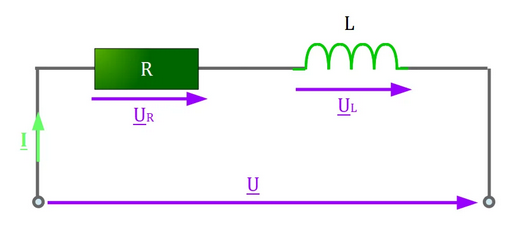
Grundlagen
| Formel |
|---|
| \( X_L = 2 \pi f L \) |
| Induktiver Blindwiderstand |
| \( \underline{Z} = R + j X_L \) |
| Komplexe Impedanz |
| \( |Z| = \sqrt{R^2 + X_L^2} \) |
| Betrag der Impedanz |
| \( \varphi = \arctan\left(\frac{X_L}{R}\right) \) |
| Phasenverschiebung (induktiv) |
Ströme und Spannungen
| Formel |
|---|
| \( \underline{I} = \frac{\underline{U}}{\underline{Z}} \) |
| Komplexer Strom |
| \( \underline{U}_R = R \cdot \underline{I} \) |
| Spannung am Widerstand (komplex) |
| \( \underline{U}_L = \underline{X}_L \cdot \underline{I} \) |
| Spannung an der Spule (komplex) |
| \( \underline{U} = \underline{U}_R + \underline{U}_L \) |
| Gesamtspannung (Zeigeraddition) |
R–C Reihenschaltung – Komplexe Wechselstromformeln
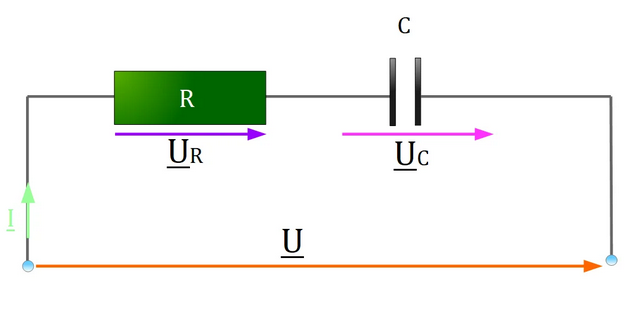
Grundlagen
| Formel |
|---|
| \( X_C = \frac{1}{2 \pi f C} \) |
| Kapazitiver Blindwiderstand (Betrag) |
| \( \underline{Z} = R – j X_C \) |
| Komplexe Impedanz |
| \( |Z| = \sqrt{R^2 + X_C^2} \) |
| Betrag der Impedanz |
| \( \varphi = -\arctan\left(\frac{X_C}{R}\right) \) |
| Phasenverschiebung (kapazitiv) |
Ströme und Spannungen
| Formel |
|---|
| \( \underline{I} = \frac{\underline{U}}{\underline{Z}} \) |
| Komplexer Strom |
| \( \underline{U}_R = R \cdot \underline{I} \) |
| Spannung am Widerstand (komplex) |
| \( \underline{U}_C = \underline{X}_C \cdot (-j) \cdot \underline{I} \) |
| Spannung am Kondensator (komplex) |
| \( \underline{U} = \underline{U}_R + \underline{U}_C \) |
| Gesamtspannung (Zeigeraddition) |